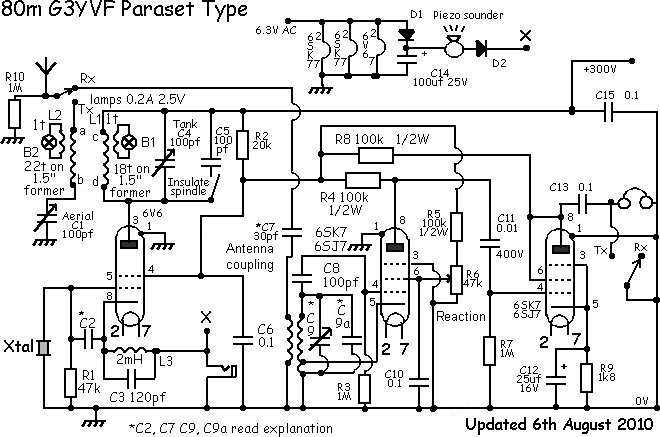
How to select the best value for C7Valve type Paraset Referring to the schematic of the Paraset circuit, shown below, we use C7 as the antenna coupling capacitor to the receiver.
In the original Paraset circuit a 100pf is used. This capacitor is there to stop absorption effects from the antenna giving rise to reaction dead spots. The "Leaky Grid Detector" used in the Paraset is very sensitive and these detectors are prone to overloading. Why change the value of this capacitor? If your receiver overloads it may not be apparent to you this is happening. The receiver will sound full of signals (particularly at night) but this not good. As you reduce the value of C7 (typically) to a smaller value than originally used the signals will get quieter BUT CLEARER and this IS what one wants for best receiver performance. Several "things" affect the correct value of C7 for your receiver, but keeping it simple, selecting the best value by trial and error is a good way of going about it. Experimenting If you would like to experiment with differing values of capacitor here you will soon find the optimum value for your receiver. This is best done in the evening when signals are strong and plentiful. The easy way to do this is to short out C7 in your Paraset with a short wire link. Now whilst on receive experiment with different values of capacitor in the antenna lead....start around 33pf and go up in value listening to the effect each time. Signals will gradually get stronger and then you may notice background "mush" increases, you might hear breakthrough and some signals will overload the receiver. When this happens you have gone too far! Best C7 we have found is ? You will probably find the best value for C7 will lie between 47pf and 82pf. Now simply fit this value capacitor in the receiver as C7.
|
|
|
|
|
|
|
|
|
|
|
|
|
|